
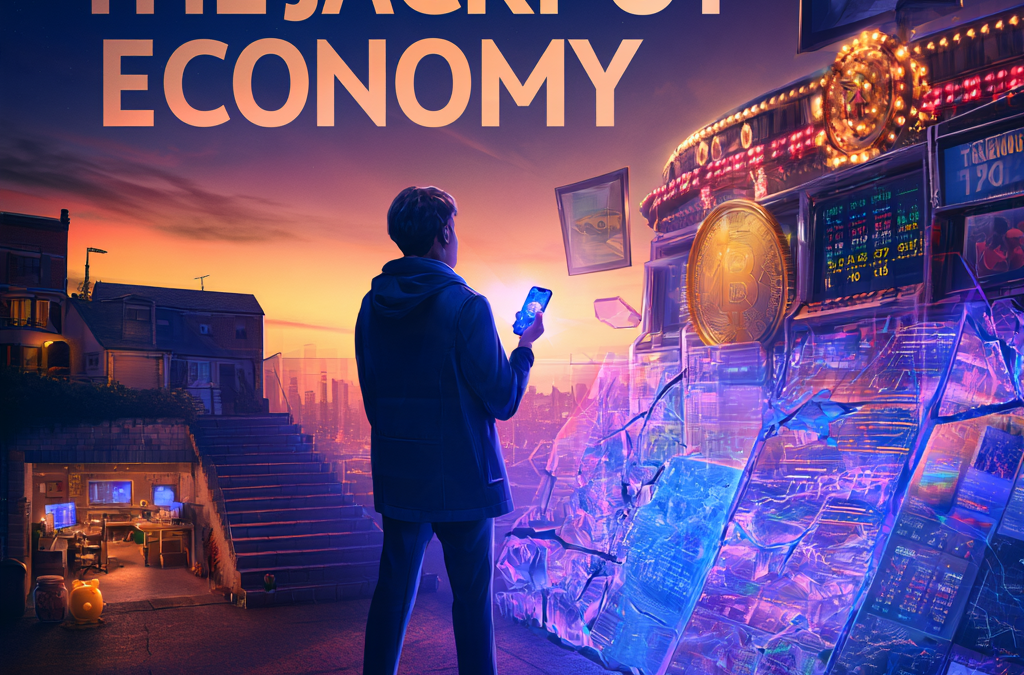
The Jackpot Economy: Why Gambling, Crypto, and Prediction Markets Feel Like the Only Way Ahead
When ordinary progress feels too slow, extraordinary risk starts to look reasonable. The rise of betting reveals more than changing financial habits—it reveals changing beliefs about opportunity, success, and the future.
A person works all week, pays the bills, checks the price of a home, and realizes the down payment still feels years away.
Then they open their phone.
Someone has turned a small cryptocurrency investment into a fortune. A sports bettor posts a winning parlay. A trader claims to have made a month’s salary predicting an election result.
The message is rarely stated outright, but it is unmistakable:
You are working for money. Other people have figured out how to escape.
That comparison can change the meaning of risk.
A bet stops feeling like an unnecessary threat to financial security. It starts feeling like a possible route to security that ordinary work has failed to deliver.
This is one of the most consequential psychological shifts behind today’s betting culture. We are watching parts of society move from a belief in gradual advancement toward a belief in the life-changing breakthrough.
Call it the jackpot economy: a culture in which dramatic financial outcomes command attention, while the slow accumulation of stability struggles to compete.
Gambling, Bitcoin, speculative tokens, and prediction markets are different activities. They have different purposes, risks, and economic structures.
But they can attract a shared emotional demand:
Give me a chance to change my life before it is too late.
First, Is Everyone Really Becoming More Reckless?
The picture is more complicated than social media makes it appear.
Pew Research Center found that the share of U.S. adults reporting any sports betting in the previous year increased modestly, from 19% in 2022 to 22% in 2025. Online sports betting rose more clearly, from 6% to 10%.
At the same time, the share saying widespread legal sports betting was bad for society increased from 34% to 43%.
That is an important paradox.
Betting can become more accessible and commercially prominent without becoming universally admired. People can participate while feeling uneasy about the industry—or about their own participation.
Nor does everyone believe cryptocurrency is the answer. Gallup’s 2025 research found that 60% of U.S. adults had no interest in buying cryptocurrency.
The more defensible conclusion is that a highly visible segment of society is encountering more opportunities to speculate, more encouragement to participate, and more stories that frame exceptional risk as a route to advancement.
The feed can make that segment look like everyone.
1. When the Traditional Path Feels Blocked, Risk Changes Meaning
The conventional promise was straightforward:
Work hard. Develop skills. Save money. Buy a home. Build a more secure future.
That path was never equally available to everyone. Still, it supplied a powerful cultural expectation: sustained effort would eventually produce progress.
For people facing expensive housing and limited financial room, that expectation can weaken.
Harvard’s Joint Center for Housing Studies reported in 2025 that the national home price-to-income ratio had reached roughly five, illustrating how far purchase prices had stretched relative to household incomes.
Housing costs alone do not explain betting behavior. But they help explain why the promise of gradual advancement may feel less convincing.
Imagine two people considering the same speculative investment.
One already owns a home, has retirement savings, and expects continued stability. Losing $5,000 means damaging an existing foundation.
The other has little savings and sees no realistic route to homeownership. Turning $5,000 into $50,000 feels like a possibility of entering a life otherwise out of reach.
The second person may think:
If I play it safe, I still do not get where I want to go.
That belief does not improve the odds. It changes the emotional comparison.
The alternative to gambling is no longer imagined as steady progress. It is imagined as permanent exclusion.
This is an interpretation of the social environment, not proof that financial frustration causes every risky decision. Plenty of comfortable people gamble, and plenty of financially stressed people avoid it.
But it is a useful way to understand why some people take risks while describing themselves as desperate for safety.
2. Feeling Behind Can Make People Chase a Breakthrough
People do not judge financial outcomes only by their absolute wealth. They also compare outcomes with expectations, previous circumstances, and reference points.
Kahneman and Tversky’s prospect theory describes how the framing of gains and losses can change decisions, including greater willingness to accept certain risks when confronting losses.
Applied cautiously to today’s culture, this suggests something revealing.
A person can have a job and positive savings yet feel psychologically “in the red” because they believe they should already own a home, support a family, or have achieved financial independence.
They are measuring themselves against an imagined timeline.
A risky trade can then feel like catching up rather than getting ahead.
There is a dangerous difference between these questions:
- “Is this a worthwhile opportunity?”
- “Could this finally make up for everything I feel I have missed?”
The second question loads a financial decision with emotional responsibilities it cannot reliably fulfill.
A trade becomes an attempt to repair status, regret, anxiety, and identity.
That is a heavy burden for a price chart.
3. Gambling Did Not Become Mainstream Overnight—Its Distribution Changed
The idea that gambling used to be universally condemned needs qualification.
Lotteries, horse racing, casinos, office pools, and informal wagers have long existed alongside moral disapproval. Different societies have repeatedly tolerated, restricted, commercialized, and criticized gambling.
What has changed dramatically is its proximity to ordinary life.
A betting opportunity can now appear inside the same device used for work, banking, entertainment, and conversations with friends.
There is less separation between deciding to gamble and being able to do it.
Advertising and commercial partnerships can also make participation feel institutionally endorsed. A product presented beside familiar sports coverage occupies a different cultural position from a discreet transaction with a bookmaker.
The World Health Organization identifies commercialization and digitization as drivers of gambling’s rapid normalization.
The psychological change is subtle:
If it is everywhere, it must be ordinary.
Ordinary, however, does not necessarily mean harmless.
4. We Have Removed Many of the Pauses That Used to Interrupt Impulse
Historically, placing some types of bets required travel, cash, planning, or a conversation.
Those steps created opportunities to reconsider.
Digital products can compress that sequence into a few taps.
Faster access does more than save time. It can reduce the interval between emotion and action.
Excitement becomes a position. Frustration becomes another deposit. A disappointing result becomes an immediate opportunity to try again.
Product design matters here. After Britain’s Gambling Commission introduced online slot design changes—including restrictions on speed and autoplay—its assessment found reduced play intensity. That is evidence from slots, not proof that every trading or prediction interface has the same effects. But it demonstrates that behavior depends partly on the environment, not simply on individual willpower.
This complicates the familiar instruction to “just be responsible.”
Personal responsibility matters. So do products designed to encourage repeated participation.
5. Social Media Shows the Jackpot More Clearly Than the Denominator
A screenshot of a spectacular win is compelling.
A spreadsheet recording hundreds of ordinary losses is less likely to travel.
That creates a distorted sample of other people’s financial lives.
The viewer sees the winning transaction, but may not see:
- Previous losses.
- Borrowed money or leverage.
- Other accounts that failed.
- Taxes and transaction costs.
- Whether the gain was actually realized.
- Sponsorship or referral income supporting the person posting it.
Even an authentic success can mislead if it is presented without the wider distribution of outcomes.
The relevant question is not whether somebody won.
It is how many people attempted the same thing, what risks they took, and what happened to everyone else.
Social media rarely makes that denominator emotionally vivid.
A visible winner begins to feel like an accessible template.
6. Investing Has Become Entertainment, Identity, and Community
Money is only part of the attraction.
A trading community can offer companionship, language, rituals, status, and a shared story about the world.
For someone who feels isolated or ignored, that experience can be meaningful.
FINRA Foundation research published in 2026, using investor survey data, found that investors who used social media reported stronger entertainment and social motivations than non-users. The report also identified a gap between confidence and measured investment knowledge among social media users and influencer followers. These are associations, not evidence that social media alone caused those differences.
The social benefit can be real. The financial judgment can still become compromised.
When an asset becomes part of a person’s identity, selling may feel like betraying the group. Criticism can feel personal. A falling price becomes a challenge to collective belief rather than new information to assess.
The community offers belonging.
The danger arrives when belonging depends on continued financial exposure.
7. Prediction Markets Let People Turn Opinions Into Positions
Prediction markets add another dimension to this shift.
They allow participants to trade contracts tied to outcomes—often a yes-or-no event with a defined payout.
These products can have legitimate uses. They can aggregate information, support forecasting, and sometimes hedge a real economic exposure. The CFTC describes both hedging and speculative uses for event contracts.
Their cultural appeal also goes beyond money.
People already argue about politics, economics, sports, and public events. A prediction market offers a way to attach a financial score to those opinions.
That can encourage intellectual discipline:
How confident am I? What would change my mind?
It can also encourage overconfidence:
I follow this subject closely, so I must have an edge.
Those are different claims.
Understanding an event does not automatically mean its probability is mispriced. A person can identify the likely winner and still pay too much for the contract.
Being right about what happens is not the same as making a profitable trade.
8. A Market Price Is a Forecast, Not an Oracle
A contract trading around 70 cents on a $1 payout is often interpreted as implying roughly a 70% probability.
That shorthand can be useful. But prices can also reflect liquidity, transaction costs, participant composition, constraints, and the details of settlement.
Thin markets are especially vulnerable to being overinterpreted.
Prediction markets may improve public understanding when they make uncertainty explicit. They may worsen it when a fluctuating price is treated as authoritative truth.
There is also a deeper problem when participants can influence the event being traded.
In September 2026, the CFTC highlighted heightened manipulation risks in certain “mention markets,” whose outcomes depend on whether a person says particular words or takes specific actions.
The larger question is uncomfortable:
What happens when people can profit from events they can also help produce?
That is a question about market design, conflicts of interest, and public trust.
9. Bitcoin Ownership and Gambling Are Not Interchangeable
It would be careless to put every Bitcoin holder, startup investor, sports bettor, and speculative trader into the same category.
Buying an asset without leverage under a long-term investment thesis differs from repeatedly wagering on short-term outcomes. A business owner taking a calculated expansion risk differs from someone chasing losses on an app.
The instrument matters. So do the behavior and purpose.
A useful distinction is:
| Activity | Question that deserves attention |
|---|---|
| Long-term asset ownership | What supports the investment thesis, and what could invalidate it? |
| Speculative trading | What evidence suggests an advantage after costs? |
| Recreational betting | Is the entertainment worth the money being spent? |
| Hedging | What existing risk does this position reduce? |
| Loss chasing | Is the next position an attempt to escape the emotional impact of the last one? |
The same asset can sit inside very different patterns of behavior.
Calling something “investing” does not establish discipline. Calling something “gambling” does not explain every participant’s motivation.
The key questions concern expectations, position size, leverage, frequency, and the ability to stop.
10. The Most Troubling Shift Is From Entertainment to Rescue
There is a fundamental difference between spending a limited amount for enjoyment and believing a speculative win is necessary to make life workable.
The first treats the cost as consumption.
The second asks uncertainty to solve a structural problem.
When betting becomes a rescue strategy, losses can deepen the conditions that made the strategy attractive in the first place.
Research by Scott Baker and colleagues found that online sports betting displaced savings and investment and worsened measures of financial fragility, with particularly pronounced effects among financially constrained households.
A New York Fed staff report, revised in October 2026, likewise estimates increased credit delinquency following mobile sports betting legalization, concentrated among consumers under 40 and in credit cards and auto loans. These are research estimates across populations, not predictions about every individual bettor.
The potential cycle is clear:
Financial pressure makes a breakthrough appealing. Losses reduce financial resilience. Reduced resilience makes the next breakthrough feel more necessary.
Understanding that cycle calls for compassion rather than contempt.
It also calls for honesty: needing a win does not make a win more likely.
11. What This Could Mean for Society’s Future
The following are plausible scenarios, not inevitable outcomes.
A widening gap in the ability to absorb losses
A wealthy person can lose speculative money and continue paying for housing, healthcare, and retirement.
Someone with little financial cushion may face lasting consequences from a much smaller loss.
If participation expands while financial resilience remains unequal, identical products can produce very different life outcomes.
The social issue is not simply who takes risks. It is who can survive being wrong.
A shorter financial time horizon
When people spend more time watching immediate outcomes, slower progress can feel unsatisfying.
Education, professional development, relationships, and business building often produce irregular rewards over years.
A culture organized around instant financial feedback may make those activities feel less attractive—even when they remain central to durable security.
The risk is a gradual loss of patience with the activities that make ordinary life work.
More of public life becoming a tradable spectacle
Prediction markets can make uncertainty more transparent.
They can also turn elections, public statements, and other shared events into financial entertainment.
A person with money riding on an outcome may consume information differently: searching for confirmation, reacting defensively, or viewing other people’s circumstances through a payout.
The challenge will be preserving the informational benefits without allowing every public event to become primarily an opportunity to wager.
Stronger backlash and closer scrutiny
Pew’s findings already show that expanding access can coexist with rising disapproval.
If visible harms grow, pressure may increase around advertising, product speed, conflicts of interest, age controls, and transparency.
The future may be a prolonged contest between commercial expansion and demands for stronger boundaries.
A market for tools that promise an edge
AI systems will likely make forecasting, strategy testing, and automated participation more accessible.
Some tools may improve analysis. Others may package unwarranted confidence.
If many participants gain access to similar tools, access itself does not guarantee an advantage. Faster competition can make genuine advantages harder to sustain.
The next persuasive sales pitch may be less “you can win” and more “our AI can win for you.”
That claim will deserve scrutiny.
12. The Answer Requires More Than Telling People to Stop
A society cannot repeatedly present extraordinary wealth as the measure of success, make ordinary milestones feel inaccessible, surround people with betting opportunities, and then explain every harmful outcome as a failure of character.
Individual choices matter. Economic opportunity, social expectations, and commercial design matter too.
A more constructive response would combine credible routes to financial progress with better understanding of probability and stronger accountability for harmful product practices.
Financial education should explain the difference between a possible outcome and a probable one, between a winning prediction and a well-priced trade, and between an exciting story and a repeatable process.
Platforms should face questions about the behavior they reward.
And society should reconsider why so many people feel ashamed of ordinary, gradual progress.
There is dignity in building a useful business, developing a skill, saving consistently, caring for a family, and improving a life without a spectacular financial event.
Those achievements deserve more visibility than they receive.
The Real Bet Is on Whether the Future Still Feels Open
The popularity of gambling and speculative markets tells us something about technology and entertainment.
It may also tell us something about hope.
Some participants are simply having fun. Some are making informed investments. Some are using sophisticated tools for legitimate purposes.
Others are trying to buy a chance at a life they no longer believe ordinary effort can provide.
That is the group society should work hardest to understand.
The deepest danger is the belief that a person must take extraordinary financial risks to deserve—or obtain—an ordinary level of security.
A healthy society needs room for ambition, experimentation, and risk.
It also needs a believable path forward for people who never hit the jackpot.
When the only future people can imagine is a winning bet, the problem is bigger than gambling.