
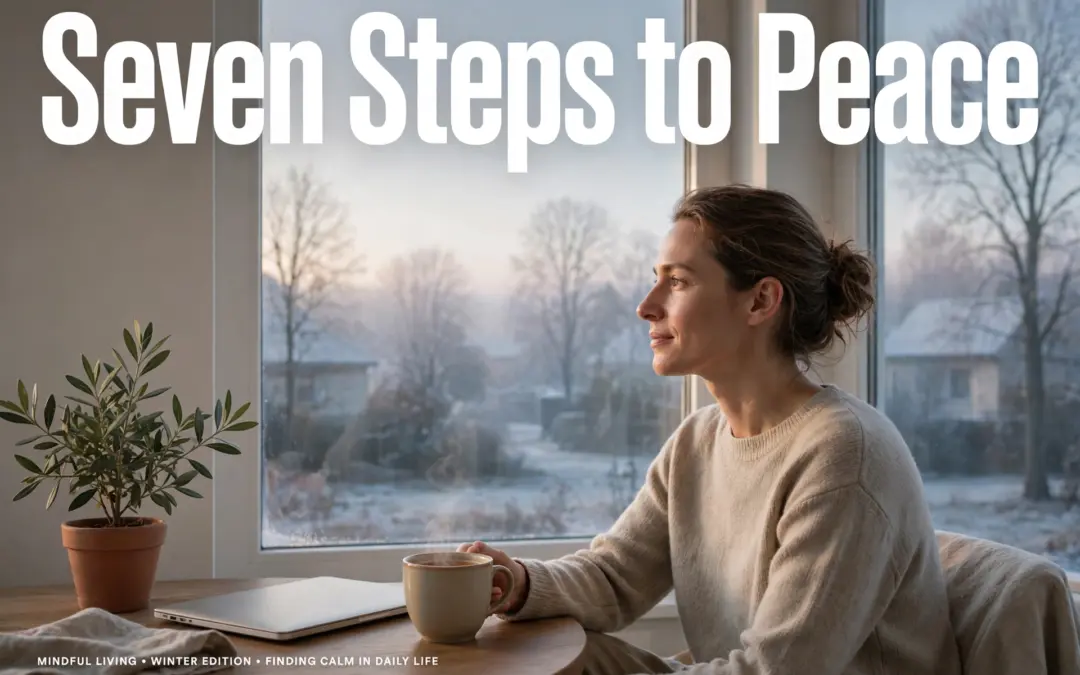
Seven Steps to Peace: A 20-Minute Reset for the Loudest Season of the Year
The holiday season is wonderful, and it is also loud. Loud kitchens, loud stores, loud group chats, loud opinions at the table. Somewhere between the travel, the cooking, the spending, and the family logistics, the quietest person in the room is usually you — running on fumes and calling it festive.
Peace is not a personality trait. It is a practice, and like every practice on this site, it works best when it is small, timed, and repeatable. This is a seven-step reset that takes about twenty minutes. You can run it before guests arrive, after they leave, or in the middle of the day when you feel the season starting to run you instead of the other way around.
Notice what the reset does not ask for: a retreat, a vacation, a new personality, or a quieter family. It works in the middle of the actual season — in a house with people in it, on a day with a schedule in it. That is deliberate. A peace practice that only works in perfect conditions is a decoration. One that works on the loudest Thursday of the year is a tool.
Step 1: Breathe Like You Mean It (2 minutes)
Slow breathing is the fastest legal way to tell your nervous system that nothing is on fire. Sit down, put both feet on the floor, and breathe in for a count of four, out for a count of six. The longer exhale is the whole trick — it is the signal your body uses to stand down.
Two minutes is enough. You are not meditating; you are changing gears. When your shoulders drop and your jaw unclenches, you have done it right.
Step 2: Walk It Off (5 minutes)
Peace has a body component, and the body component is movement. A five-minute walk — around the block, down the driveway and back, anywhere with sky over it — clears the stress chemistry that sitting and scrolling only concentrate.
Leave the earbuds out. The point is not entertainment; it is exposure to the actual world: cold air, real light, your own footsteps. Some of the clearest thinking you will do all season happens at walking pace.
Step 3: Sit in Silence (3 minutes)
Not guided audio, not a podcast about silence — actual silence. Three minutes of it feels longer than you expect, which is exactly the information you need: it shows you how rarely your mind gets an empty room.
Let the thoughts queue up and pass. You are not solving anything in these three minutes. You are remembering that you are allowed to not solve anything for three minutes.
Step 4: Write One Gratitude Note (3 minutes)
Not a list of ten things, not a journal entry — one note, to one person, saying one true thing. Gratitude gets vague and useless when it stays abstract. It gets powerful when it has a name and a stamp on it.
- Pick someone whose effort you have been enjoying without mentioning
- Say the specific thing they did, not just “thanks for everything”
- Send it today, while it is still true and warm
Three minutes. One person noticeably happier, and — this is the part nobody believes until they try it — you quieter than when you started.
Step 5: Put the Phone in Another Room (the whole reset, and beyond)
Every step in this routine works better with the phone out of reach, because the phone is the season’s loudest instrument. It carries the news, the sales, the comparisons, and everyone else’s emergencies, all tuned to interrupt.
You do not need a digital detox or a dramatic announcement. You need twenty minutes where the device is in a drawer and the world has to wait. It will wait. It always does.
Step 6: Forgive One Thing (3 minutes)
Here is the step most peace routines skip, because it is the hard one. Holiday stress is rarely just about the present — it arrives carrying last year’s argument, the sibling comment from 2019, the invitation that never came. Peace is hard to reach while you are still holding the receipts.
Forgiving one thing does not mean declaring it fine. It means deciding that you are done paying interest on it. Pick the smallest item on your list — one remark, one old slight — and consciously set it down. Not for them. For the twenty minutes, and the season, you are trying to reclaim.
Peace is not the absence of noise. It is the decision to stop carrying it.
If working through the heavier items on that list is part of your inner-life practice, the structured exercises in The Calm Mind Workbook ($29) — including its crisis resources and a section from licensed clinical psychologist Dr. Donna Duffin — are built for exactly that slower work. The reset above is the daily version; the workbook is the deep one.
Step 7: Protect Tonight’s Sleep (starts now, pays off at 10 p.m.)
The reset ends with a decision, not an exercise: tonight, sleep is the plan. Poor sleep is the multiplier on every other holiday stressor — it makes the noise louder, the patience shorter, and the worries bigger than they are.
- Set a lights-out time now, while you are calm enough to mean it
- Last caffeine by mid-afternoon
- The phone charges outside the bedroom, where it cannot negotiate
One protected night will do more for your peace than a week of good intentions.
When to Run It
Timing matters less than repetition, but three windows work especially well:
- Morning, before the house wakes up. The reset is easiest when the day has not started spending your attention yet, and it sets a baseline you can notice drifting later.
- The hour before guests arrive. Hosts run on adrenaline and checklists; twenty quiet minutes beforehand is the difference between performing the holiday and being in it.
- After a hard moment. An argument, bad news, a bill you were not expecting — the reset is a circuit breaker. Walk first if you need to; the order bends, the practice holds.
If twenty minutes truly does not exist, run the short version: breathe, walk, phone away. Seven minutes. A partial practice done beats a perfect one postponed, every single time.
The Whole Routine, On One Line
Breathe (2) → walk (5) → silence (3) → gratitude note (3) → forgive one thing (3) → phone away throughout → sleep protected tonight. Twenty minutes, seven steps, no equipment, no app, no cost.
Run it once and it is a nice break. Run it daily through the season and it becomes something better: proof, in your own experience, that peace is a skill you can practice — designed, like everything else in a well-built life, rather than discovered by accident. More practices for mind, body, and inner life live at XTC Life.